
Chinese Foreign Minister Wang Yi is set to attend the BRICS National Security Advisors meeting in New Delhi on June 22-23. The high-level gathering will address international security challenges, regional issues, and prepare for the upcoming BRICS Summit in India. Wang Yi is also expected to hold bilateral talks with India's NSA Ajit Doval, focusing on India-China border issues.
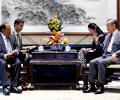
Chinese Foreign Minister Wang Yi will visit India for border talks with NSA Ajit Doval, ahead of PM Modi's visit to China for the SCO summit. The visit aims to improve bilateral ties after recent tensions.
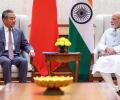
China's Foreign Minister Wang Yi expressed China's anticipation for Prime Minister Narendra Modi's visit to the Shanghai Cooperation Organisation (SCO) summit, emphasizing the importance of strong India-China relations and mutual cooperation.
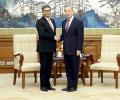
Foreign Secretary Vikram Misri on Monday called on Chinese Foreign Minister Wang Yi and discussed issues of bilateral interest.
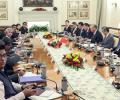
Chinese Foreign Minister Wang Yi's visit to India focuses on border talks with NSA Ajit Doval, amidst efforts to rebuild relations after the Galwan Valley clashes and rising India-US tensions.

National Security Advisor Ajit Doval is in Beijing for the 25th round of Special Representatives talks on the India-China boundary issue with his Chinese counterpart Wang Yi. These crucial discussions precede Chinese President Xi Jinping's anticipated visit to India for the BRICS summit, offering a potential opportunity for a meeting with Prime Minister Narendra Modi. The talks aim to address the long-standing border dispute and recurring tensions, with both sides emphasising the importance of peace and tranquillity for bilateral relations amidst recent reports of aggressive Chinese posturing in Arunachal Pradesh.
National Security Advisor Ajit Doval engaged in Special Representatives talks with Chinese Foreign Minister Wang Yi in Beijing, focusing on the India-China boundary question and enhancing bilateral relations. These crucial discussions precede Chinese President Xi Jinping's anticipated visit to New Delhi for the BRICS summit, aiming to address persistent border differences and stabilise ties strained by past conflicts like the Galwan Valley clash.

The Jaishankar-Wang talks came amid the dragging border row in eastern Ladakh that entered its fifth year in May.
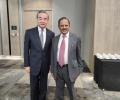
National Security Advisor Ajit Doval held a meeting with top Chinese diplomat Wang Yi during which he emphasised the need for continuing efforts to restore peace and tranquillity in the border areas to remove the 'impediments' to normalcy in bilateral relations.

External Affairs Minister S Jaishankar met his Chinese counterpart Wang Yi in Manila, reiterating that peace and tranquillity in border areas are prerequisites for normal India-China relations. He stressed the importance of mutual respect, interest, and sensitivity, while also raising concerns about market access, trade imbalance, and supply chain uncertainties.

India on Tuesday conveyed to China the importance of maintaining peace and tranquility along the Line of Actual Control (LAC) for overall bilateral ties as national security advisor Ajit Doval held talks with Chinese Foreign Minister Wang Yi focusing on delimitation of the frontier and sustaining work on trans-boundary cooperation.
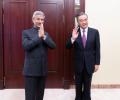
External affairs minister S Jaishankar has told his Chinese counterpart Wang Yi that the two sides should work for an early resolution of the remaining issues along the LAC in eastern Ladakh to restore peace and tranquility in the border areas as this has been an essential basis for progress in Sino-India ties.

National Security Adviser Ajit Doval held "constructive" talks with Chinese Foreign Minister Wang Yi in New Delhi, focusing on the normalisation of bilateral ties. The discussions reviewed recent developments and progress towards rebuilding trust after the eastern Ladakh border standoff. Both sides have implemented measures, including disengagement pacts and high-level meetings, to improve relations.

Indian and Chinese military officials have held corps commander-level talks in Arunachal Pradesh to review the Line of Actual Control (LAC) situation, following recent Special Representative discussions aimed at de-escalating border tensions and fostering bilateral ties.
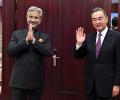
China is ready to take "conciliatory steps" in order to avoid new violations of the obligations on the India-Chinese border, Chinese Foreign Minister Wang Yi said on Friday, a day after holding a crucial meeting with External Affairs Minister S Jaishankar over the current standoff in Ladakh. Speaking during a joint press conference with Russian Foreign Minister Sergey Lavrov, Wang said troops and equipment should be withdrawn from the Line of Actual Control (LAC).

India and China have agreed to advance discussions on an "Early and Substantial Harvest" of boundary delimitation and border management during the 25th round of Special Representatives talks between National Security Advisor Ajit Doval and Chinese Foreign Minister Wang Yi in Beijing. Both sides reached an eight-point consensus, committing to the 2005 Agreement on Political Parameters and Guiding Principles for Settlement. Key outcomes include enhancing border management, improving understanding of the Line of Actual Control, establishing new meeting points and hotlines, and continuing cooperation on trans-border rivers and pilgrimage.

Chinese President Xi Jinping's first visit to India in seven years for the BRICS Summit and bilateral talks with Prime Minister Narendra Modi is set to address crucial aspects of India-China relations, including trade, investment, and persistent border tensions.

Chinese Foreign Minister Wang Yi met with National Security Advisor Ajit Doval in New Delhi, stressing the importance of respecting each other's "core interests" and implementing leaders' consensus for stable bilateral relations. Wang highlighted that India and China should view each other as partners, not rivals, and properly handle sensitive issues like the border dispute to foster cooperation and accelerate the modernisation of the Global South.

External Affairs Minister S Jaishankar and his Chinese counterpart Wang Yi met in Moscow on Thursday amid hopes of a possible breakthrough in reducing tensions along the Line of Actual Control (LAC) in eastern Ladakh.
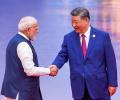
Ahead of Xi Jinping's visit, National Security Advisor Ajit Doval and Chinese Foreign Minister Wang Yi held extensive talks in Beijing on August 25 on the boundary issue and reached an eight-point consensus.

Prime Minister Narendra Modi, in bilateral talks with Chinese President Xi Jinping, emphasized that both nations must show sensitivity to each other's core issues and be guided by mutual respect, sensitivity, and interest. Modi highlighted the critical importance of peace and tranquillity along the Line of Actual Control for the development of India-China relations, while also addressing concerns regarding Taiwan and Tibet.

China and India should put their differences on the border issue at a "proper position" in bilateral relations and stick to the "right direction" of bilateral ties, Chinese Foreign Minister Wang Yi said on Friday.
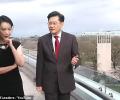
Qin, 57, was made the foreign minister in December last year, superseding many seniors, earning the distinction of a rising star in the ruling Communist Party of China.

Chinese Foreign Minister Wang Yi has said that during his recent visit to India, he "keenly felt" that both sides had agreed to adhere to the leaders' consensus that the two countries are not a threat to each other and handle and manage their differences.

Foreign Secretary Vikram Misri held extensive discussions with China's Vice Foreign Minister Hua Chunying and other senior officials in Beijing, reviewing bilateral relations, trade, cultural exchanges, and emphasising peace and tranquillity in border areas. His visit aims to advance the vision of both nations as development partners.
National security advisor Ajit Doval arrived in Beijing on Monday for a two-day visit to take part in the Special Representatives talks on the India-China boundary question with his Chinese counterpart and Foreign Minister Wang Yi.

Chinese Foreign Minister Wang Yi arrived in India Thursday evening in the highest-level visit between the two countries after the ties came under severe strain following the eastern Ladakh standoff nearly two years ago.

Chinese President Xi Jinping is in New Delhi for the 18th BRICS Summit, where he is scheduled to hold bilateral talks with Prime Minister Narendra Modi. This visit, his first to India in nearly seven years, comes amidst efforts to normalise India-China relations following the 2020 Eastern Ladakh standoff and is expected to have significant implications for bilateral ties and BRICS cooperation.

Indian and Chinese armies held their first high-level commanders' flag talks in the Arunachal Pradesh sector, following Special Representatives dialogue. These talks, aimed at maintaining peace along the Line of Actual Control, occurred amidst reports of aggressive military posturing and just days before Chinese President Xi Jinping's visit to India for the BRICS summit.

In July, tension emerged in Taksing, a remote village in the Upper Subansiri district of Arunachal Pradesh after locals sighted PLA soldiers.

Chinese Foreign Minister Wang Yi stated that President Xi Jinping and Prime Minister Narendra Modi reached a crucial consensus during the BRICS summit, agreeing that China and India should be partners, not rivals. The leaders pledged to maintain peace and tranquility in border areas, deepen cooperation, and support each other in multilateral forums, aiming to strengthen the Global South and promote a multipolar world order.

The Galwan clashes indicate to the limitations in relations if they do not address border stability, points out Srikanth Kondapalli.
The Galwan clashes indicate to the limitations in relations if they do not address border stability, points out Srikanth Kondapalli.

Two-time Olympic medallist PV Sindhu's campaign at the World Championships concluded after a quarterfinal defeat to China's Wang Zhi Yi. Sindhu, a two-time world champion, fought hard but ultimately lost in three games, ending her bid for a record sixth medal at the prestigious event and India's hopes for a women's singles medal.

Two-time Olympic medallist PV Sindhu expressed disappointment after her pre-quarterfinal defeat at the World Championships, suggesting her opponent Wang Zhi Yi's mid-match cramps might have been tactical. Sindhu also reflected on her own performance, acknowledging the need for greater patience and improved stroke-making, while vowing to continue her pursuit of a sixth World Championships medal.

'Xi is conveying that China is a pre-eminent power, and India should modulate its actions or approaches accordingly.'

Former CDS Anil Chauhan stated that China poses a long-term and comprehensive challenge to India, with the boundary issue remaining unresolved due to differing perceptions of the Line of Actual Control. However, he emphasised that India's ties with Beijing cannot be solely defined by border disputes, advocating for engagement through platforms like SCO and BRICS. He also highlighted the broader global geopolitical flux and instability in India's neighbourhood as significant security concerns, stressing the need for self-reliance.

Satwiksairaj Rankireddy and Chirag Shetty advanced to the men's doubles quarterfinals at the World Championships, securing a potential third medal. However, India faced a setback with the elimination of two-time Olympic medallist PV Sindhu and Ayush Shetty in their respective singles matches. The women's doubles pair of Treesa Jolly and Gayatri Gopichand also reached the quarterfinals.

Former world No. 1 PV Sindhu bowed out of the BWF Badminton World Championships in New Delhi on Thursday after losing to China's Wang Zhi Yi in the Round of 16.

In recent years, China and Russia have pushed for de-dollarisation within BRICS, which India has resisted. One reason is that India does not want to hurt its relationship with the United States, and another is the fear of China controlling trade because the renminbi is considered the strongest currency in the bloc today.
